Michigan fleet guides · 2026
5 winter traction checks for Michigan, Ohio and Indiana (2026)

Start with the state rule, then check the equipment and the stop decision. Chains are a traction tool, not a reason to keep moving in unsafe conditions.
The cited Michigan, Ohio and Indiana statutes allow chains for snow or ice conditions; those sections do not establish a truck chain-control mandate. Studded tires have separate limits. A winter plan still needs a safe place to fit equipment and a weather stop rule.
| # | Item | Best for | What ready looks like |
|---|---|---|---|
| 1 | Check Michigan’s chain exception | Trucks on snowy Michigan routes | Chain use fits the safety exception in MCL 257.710. |
| 2 | Separate Ohio studs from chains | Trucks crossing into Ohio | The stud season and the snow-or-ice chain exception are distinct. |
| 3 | Check Indiana’s equipment rule | Trucks crossing into Indiana | Chain use and any stud size, wear and season limits are checked. |
| 4 | Practice with the equipment | Drivers carrying chains | The equipment fits and drivers can fit it in a safe location. |
| 5 | Keep the weather stop rule first | Dispatchers deciding whether to continue | The winter plan includes stopping, not just adding traction. |
Want notice when Helm can take Michigan fleets? Join the founding carrier list.
1. Check Michigan’s chain exception
Best for: Trucks on snowy Michigan routes.
Metal in contact with the road is generally barred, but a driver may use a tire chain of reasonable proportion when required for safety because of snow, ice or other conditions tending to cause a skid (MCL 257.710).
2. Separate Ohio studs from chains
Best for: Trucks crossing into Ohio.
Studded tires are allowed only from November 1 through April 15. The rule does not apply to tire chains used when snow or ice is on the road or nearby (ORC 5589.081).
3. Check Indiana’s equipment rule
Best for: Trucks crossing into Indiana.
Tire chains of reasonable proportions are allowed for snow and ice. Studs are allowed from October 1 to May 1 within size and wear limits (IC 9-19-18-3).
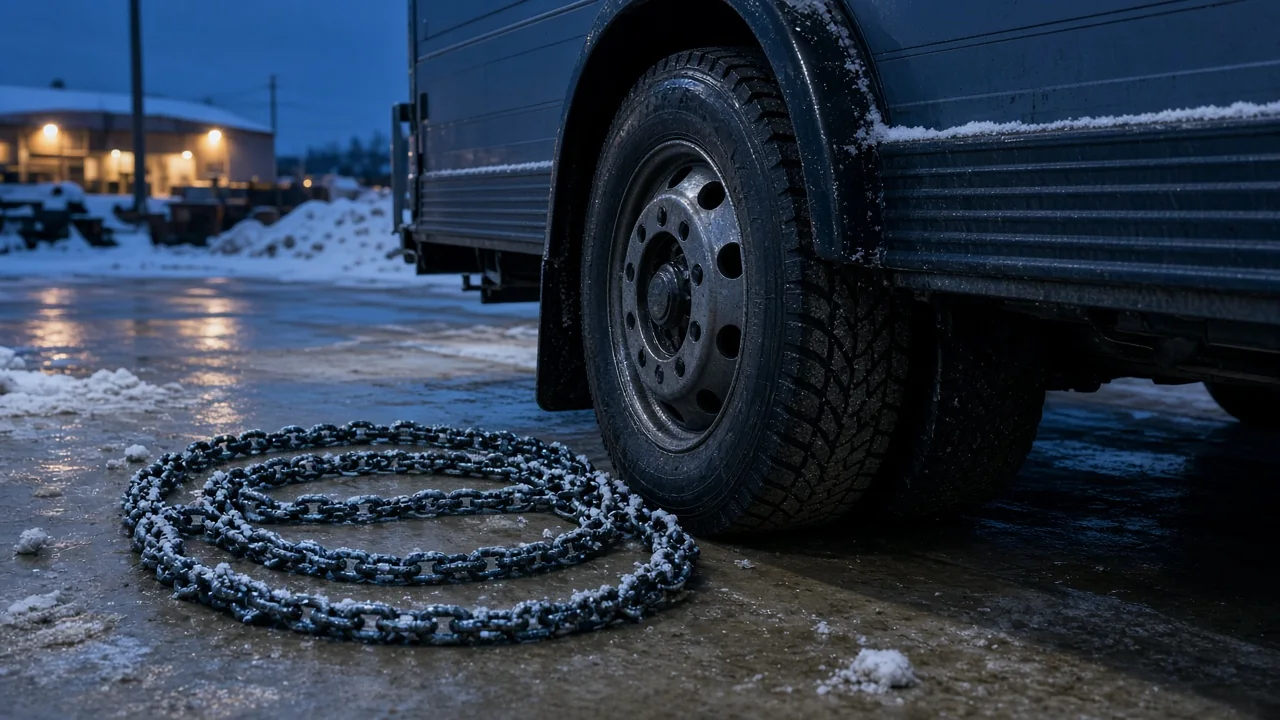
4. Practice with the equipment
Best for: Drivers carrying chains.
Drivers who carry chains should practice fitting them before the season and pull them off once the road is clear, since metal on bare pavement can fall outside the exceptions above.

5. Keep the weather stop rule first
Best for: Dispatchers deciding whether to continue.
- Name which trucks carry chains or traction devices and where they are stored.
- Train drivers to fit them in a safe spot, off the travel lane.
- Keep the stop rule from 49 CFR 392.14 first: chains do not replace a weather stop.
Read the winter operations policy for Great Lakes fleets for the wider plan.
FAQ
Does Michigan require trucks to carry chains?
No. MCL 257.710 allows a tire chain of reasonable proportion when required for safety because of snow, ice or other conditions tending to cause a skid. It does not require carrying them.
Are studded tires legal on trucks in Ohio?
Only from November 1 through April 15 under ORC 5589.081, except for retractable studs kept retracted. The section does not apply to tire chains used when snow or ice is on the road.
When are studs allowed in Indiana?
From October 1 to the following May 1, for studs that meet the size and wear limits in IC 9-19-18-3(d).
Do chains change what a driver must do in a storm?
No. 49 CFR 392.14 still requires extreme caution and reduced speed, and stopping when conditions become dangerous enough.
Sources
- MCL 257.710: Tires; traction devices (accessed Nov 5, 2026)
- ORC 5589.081: Studded tires (accessed Nov 5, 2026)
- IC 9-19-18: Tires (Indiana Code 2026) (accessed Nov 5, 2026)
- 49 CFR 392.14: Hazardous conditions (eCFR, accessed Nov 5, 2026)
Source access notes: federal rule links retain the Nov 5 source review from the original guide. Automated access was unavailable during this format update.
Join the founding carrier list.
One email when Helm Partners launches, plus a DeepView briefing. No spam, and we do not sell your information.